Canal Seepage and Summer Groundwater: Why Crawlspaces Get Wet in July
Where the valley's groundwater comes from, and why it peaks in summer.
MERIDIAN, IDAHO · ADA COUNTY
Groundwater under the floor in July, a line that split during a January cold snap, an upstairs bathroom showing through the kitchen ceiling. Say where it's wet: (208) 908-0878.
Meridian water damage tends to arrive in two seasons. From spring into fall, canal water and irrigation raise the ground water under houses and push moisture into crawlspaces. From late fall into March, cold snaps freeze lines in crawlspaces, garages and outside walls. Restoration companies handle both: extraction, drying checked with meters, and the repairs after. Ceiling, wall, floor or crawlspace: (208) 908-0878.
What this page is for. It sorts the water by the time of year and by the part of the house it reached, because both change where a restoration company looks first. Read the half of the year you're in, find what got wet, and call with that in mind. The company does the rest of the sorting on site.
What it isn't. Meridian Water Damage Restoration is a phone line and a website. It doesn't own fans or trucks. The number passes your call to an independent local company, and everything after that is between you and them.
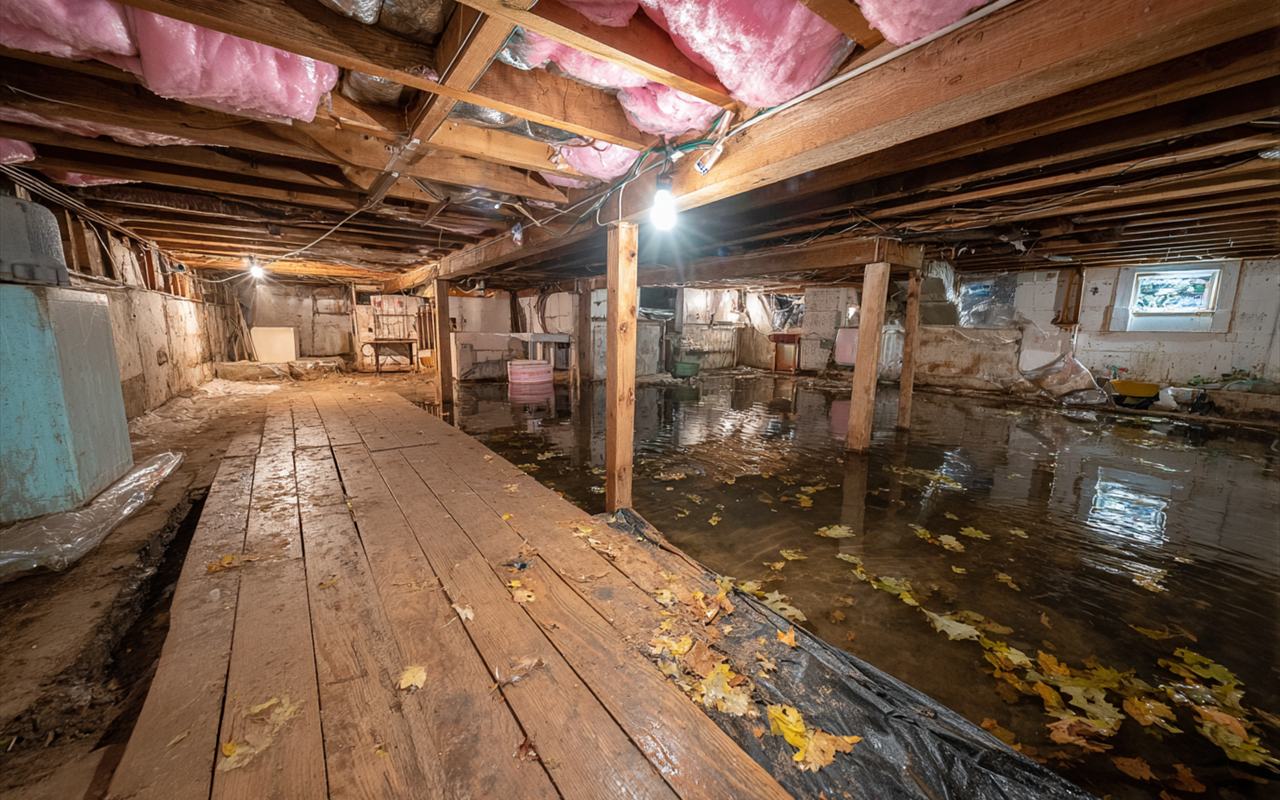
What you see: a damp or musty crawlspace hatch, standing water on the vapor barrier, a dark ring on the foundation wall, carpet near an outside wall that never quite dries, or a wet spot by the water meter or the sprinkler valve box.
What it usually means: water from the canals, the laterals and flood-irrigated fields soaks into the ground all summer, and in parts of the valley it raises the water table under neighborhoods. Pressurized irrigation lines run right up to many foundations, and a cracked fitting can feed the soil next to the house for weeks. Inside, an AC condensate line can back up during the hottest stretch.
What happens next: a company pumps out standing water, measures the joists, subfloor and sill plate, and sets drying under the floor and in the rooms above. Over the floor or under it: (208) 908-0878. More: crawlspace and basement water · restoration and mitigation.
What you see: a ceiling drip in a room under the attic, a wet baseboard on an outside wall, water spreading from under a kitchen sink cabinet, ice on a hose bib that won't shut off, or water on the garage floor after the thaw.
What it usually means: a supply line froze and split. In Treasure Valley homes the usual spots are the crawlspace, exterior walls, garage ceilings and lines to outside faucets. The split stays plugged with ice until the weather warms, so the water often shows up a day or two after the coldest night.
What happens next: the water goes off at the main, the company traces every wet path (there's often more than one break after a hard freeze), opens what has to be opened, and dries to readings. Freeze, leak or groundwater: (208) 908-0878. More: frozen and burst pipe water damage · ceiling water damage.
Spring, in between. Late-winter snowmelt on frozen ground can run toward a foundation and into window wells before the canals ever fill. That's covered in snowmelt and late-winter water.
What a house is sitting on decides where the water goes once it gets past the floor covering. Many Treasure Valley homes, newer subdivisions included, are built over a crawlspace; others have a full or daylight basement, and some sit on a slab.
| Under the floor | Where water collects | What hides it | What to say on the call |
|---|---|---|---|
| Crawlspace | On the vapor barrier and in low corners of the dirt | Insulation between the joists, the floor covering above | "It's a crawlspace house," where the hatch is, and whether you've seen water under there |
| Basement | Along the base of the walls, at window wells, under carpet pad | Finished walls and carpet | Whether the basement is finished, and if water came from a window well or a wall |
| Slab | Under flooring and into the bottom of walls | Laminate, vinyl plank and tile that look dry on top | That it's a slab, and where the floor feels damp or cool |
If you don't know which you have, look for a crawlspace hatch in a closet floor, the garage wall or outside near the foundation. The company will check either way. More on house types: crawlspace, slab or basement.
A stain, a bulge or a drip at a light fixture means water is sitting on the drywall from above, usually an upstairs bathroom, a frozen attic line or a roof opening. Wet ceiling drywall can come down without warning, and the insulation above it holds water for days. A company finds the source and tests the ceiling before deciding what stays. Call (208) 908-0878. Ceiling water damage
Swollen baseboard, paint that bubbles, or a soft spot at the bottom of the drywall means water has gotten inside the wall cavity. It wicks upward and sideways where you can't see it. Meters show how far, and the wall gets opened only where it has to be. Call (208) 908-0878. Wet walls and drywall
Carpet that squishes, laminate or vinyl plank lifting at the seams, or hardwood starting to cup. Over a crawlspace, the water doesn't stop at the floor; it goes into the subfloor and down to the joists. Call (208) 908-0878. Floors and carpet
Standing water on the vapor barrier, a musty smell at the hatch, or water at a basement window well. Under-floor water rarely dries by itself in irrigation season, because the ground keeps feeding it. Call (208) 908-0878. Crawlspaces and basements
Water appeared during or right after a freeze. Expect more than one wet spot, and expect some of them to be hidden in walls and under the floor. Call (208) 908-0878. Frozen and burst pipes
That's what the full restoration and mitigation job is for: find every wet area, get the water out, dry to readings, then put it back. Call (208) 908-0878. Restoration and mitigation
Yes, once it reaches the house. Water on the dirt is a drainage condition, but water that soaks the insulation, joists, sill plate or subfloor is wetting the structure, and that's what a restoration company dries. Many crawlspaces in the valley see some seasonal moisture; standing water, wet insulation and a musty smell inside the house are signs it has gone past normal.
The water runs onto the vapor barrier and the dirt, soaks the insulation near the break and often wets the subfloor above. After the water is shut off and the line is repaired, the company pumps out what's standing, pulls wet insulation, and dries the joists and subfloor until the readings match dry wood elsewhere in the house.
Sometimes. If the drywall is still firm, the leak was clean and short, and the insulation above can be pulled or dried, a ceiling can often be dried in place. A sagging, soft or stained-through ceiling usually has to be cut out. Moisture readings decide, not appearances.
North Meridian
South Meridian
Central Meridian
East
North
South and West
Where the valley's groundwater comes from, and why it peaks in summer.
The layout that puts water over the kitchen, and how to trace it.
The factors behind a water damage bill, without prices.
A Meridian restoration company is a call away: (208) 908-0878.
Call (208) 908-0878
